Author: yildk

  • As a Man Thinketh: The Literary Secret Behind Modern Self-Help

    James Allen was a British philosophical writer born in Leicester, England, in 1864.

    His early life was marked by deep tragedy when his father was brutally murdered by robbers when Allen was only fifteen, forcing him to leave school and work as an executive secretary to support his family.

    Despite his hardships, Allen spent his nights reading and reflecting on the ultimate power of the human mind.

    In 1903, he published his literary masterpiece, “As a Man Thinketh“, a tiny book of just a few chapters that would go on to shape the entire modern self-help industry.

    Inspired by ancient spiritual philosophies, Allen argued that a person’s character, health, and external life circumstances are a direct, unavoidable reflection of their inner thoughts.

    Allen famously wrote that the human mind is like a garden, which can be either intelligently cultivated or allowed to run completely wild.

    His timeless message that you are entirely responsible for your own mental attitude deeply inspired iconic figures like Norman

    Vincent Peale, Og Mandino, and thousands of motivational speakers worldwide.

    James Allen:The James Allen Free Library & Literary Trust Archives (jamesallen.org) and his biographical landmarks.
  • The Two Fathers That Created Robert Kiyosaki’s Financial Empire

    Robert Kiyosaki was born in Hawaii into a hard-working family, but his entire perspective on money was shaped by a unique childhood dynamic. He grew up watching two influential figures: his biological father, a highly educated school superintendent whom he called “Poor Dad,” and his best friend’s father, a self-made multimillionaire entrepreneur whom he called “Rich Dad”.

    While his Poor Dad always advocated for traditional academic success, job security, and a steady paycheck, his Rich Dad taught him how money actually works.

    Rich Dad explained that the wealthy do not work for money; instead, they make money work for them through investing and building assets. This fundamental contrast inspired Kiyosaki to pursue financial freedom rather than corporate comfort.

    Before becoming a global financial guru, Kiyosaki served as a Marine Corps helicopter pilot during the Vietnam War and later encountered significant business failures, including a bankrupt surfing wallet enterprise. Applying the lessons of his Rich Dad, he overcame these setbacks by aggressively investing in real estate and financial education.

    In 1997, he published “Rich Dad Poor Dad,” a masterpiece that challenged conventional wisdom by declaring that your house is not an asset and that traditional schooling fails to teach financial literacy. The book became a massive global phenomenon, selling over 40 million copies and transforming how generations think about wealth.

    Kiyosaki’s core philosophy remains powerful: true financial independence is achieved only when your passive income streams completely surpass your living expenses.

    Robert Kiyosaki:The Rich Dad Company Historical Archives (richdad.com) and his personal biographical landmarks.

  • W. Clement Stone: The Pioneer of Positive Mental Attitude

    W. Clement Stone was born in Chicago into poverty, and after his father passed away, he began selling newspapers on the streets at the young age of six to support his family. By 1922, with a massive drive to succeed and a small $100 loan, he established his own insurance agency, laying the foundation for a multi-million-dollar empire.

    Stone believed that financial success was deeply connected to one’s mindset. He co-authored the legendary book “Success Through a Positive Mental Attitude” alongside Napoleon Hill, introducing a philosophy that aimed to help millions overcome despair and build high-achieving lives.

    His work had a direct, life-saving impact on Og Mandino. When Mandino was struggling with severe alcoholism and was on the verge of ending his life, he discovered Stone’s book in a local library. The principles within those pages completely changed Mandino’s destiny, eventually leading him to become a successful writer himself.

    Stone lived by his own philosophy until the age of 100, donating over $275 million to various charities, mental health organizations, and educational development programs during his lifetime.

    W. Clement Stone:The Napoleon Hill Foundation & Positive Mental Attitude Archives (naphill.org) and his biographical landmarks.

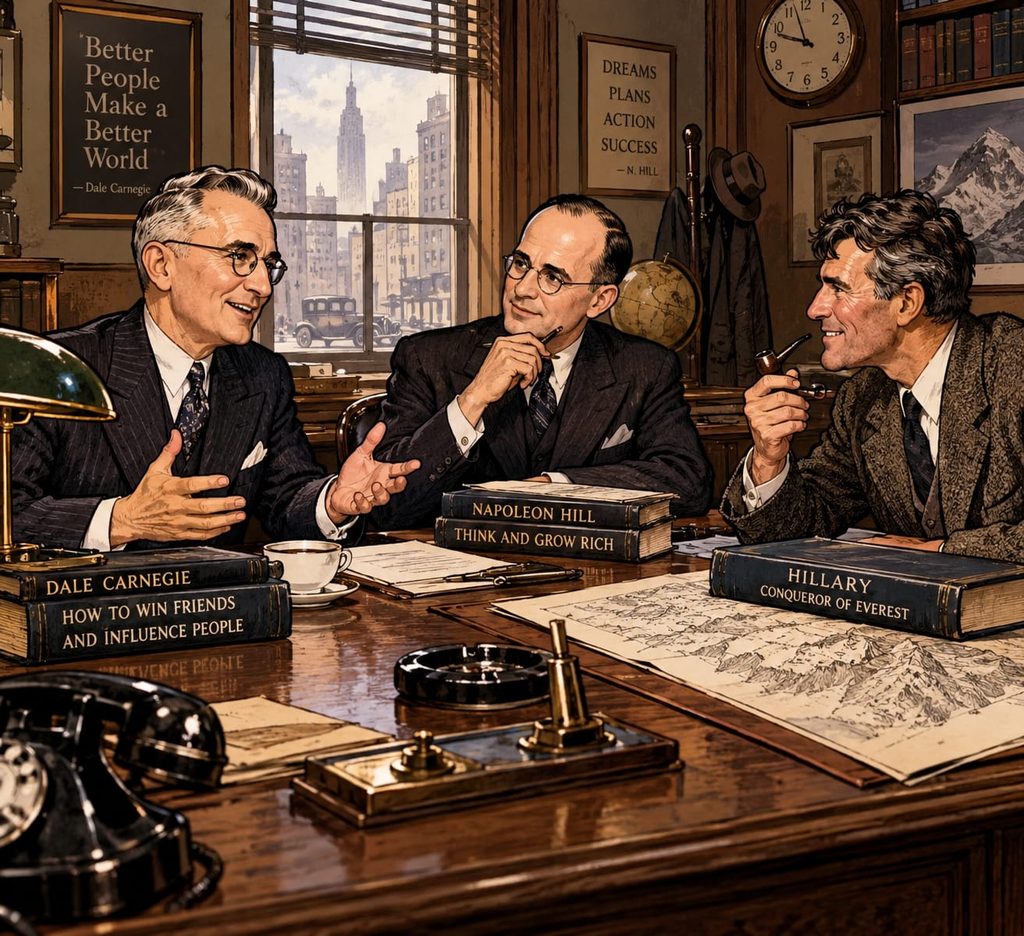
  • The Untold Story Behind Dale Carnegie’s Masterpiece

    Dale Carnegie was born into a poor farming family in Missouri, but his destiny completely changed when he discovered the power of public speaking. In 1912, broke and living in a YMCA room in New York, he managed to convince the manager to let him teach a night class on public speaking to businessmen.

    Carnegie did not teach grammar or literature; he taught adults how to overcome fear, build confidence, and communicate effectively. He quickly realized that the biggest problem successful businessmen faced wasn’t a lack of technical skills, but their inability to handle and influence people.

    Since no textbook existed on this subject, Carnegie began conducting deep research, analyzing the lives of history’s greatest leaders, from Abraham Lincoln to John D. Rockefeller. He even hired a researcher to spend months in libraries discovering how these iconic figures managed human relations.

    After years of testing these principles in his actual classes, he published “How to Win Friends and Influence People“ in 1936. The book was a phenomenal, unexpected success, selling out its first 17 editions in just a few months and becoming one of the most influential bestsellers in human history.

    Carnegie’s core message remains revolutionary: you can change other people’s behavior simply by changing your own attitude toward them.

    Dale Carnegie: The Dale Carnegie Training Institute – Official Historical Archives (dalecarnegie.com) and his biographical landmarks.


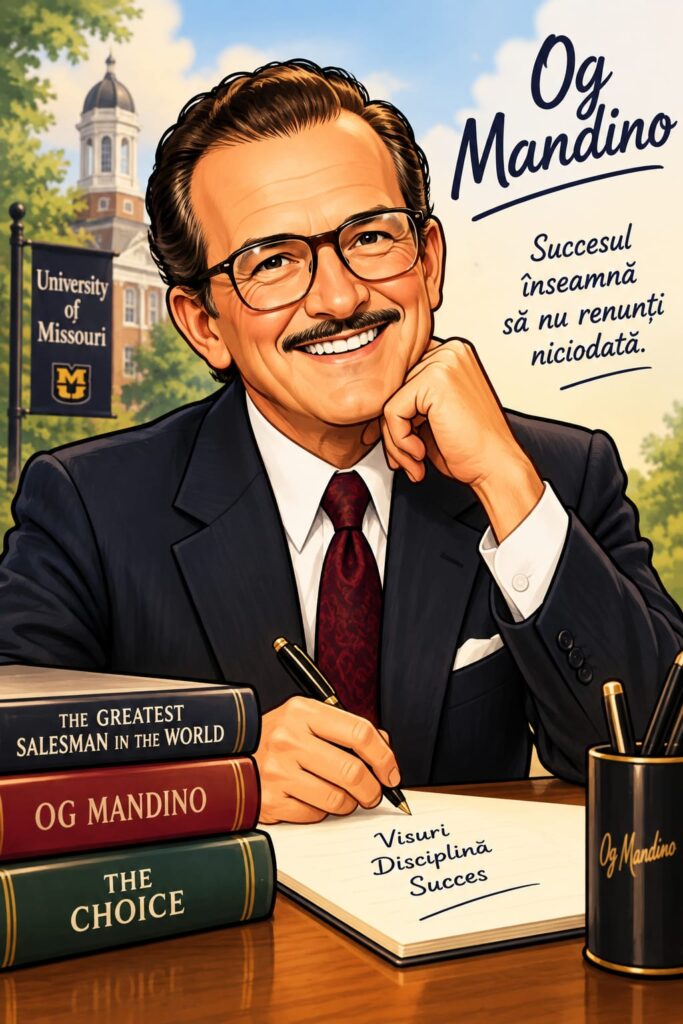
  • Og Mandino

    Augustine “Og” Mandino II was born on December 12, 1923, and was named after his paternal grandfather.

    As a teenager, he was the editor of his high school newspaper and planned to attend the University of Missouri for journalism.

    However, in the summer of 1940, just before he started college, his mother died suddenly of a heart attack while preparing his lunch in the kitchen.

    After this tragedy, Mandino decided to work in a paper mill until 1942, when he enlisted in the United States Army Air Corps.

    He became a military officer and piloted a B-24 Liberator bomber, participating in 30 combat missions over Germany during World War II.

    During this period, he flew alongside his comrade-in-arms, the famous pilot and movie star James Stewart.

    Mandino kept an autographed 8×10 photo of Stewart for his entire life, which he displayed on the wall of his home office where he later wrote all of his successful books.

    After completing his military service, Mandino discovered that very few companies were hiring former bomber pilots.

    As a result, he took a job as an insurance salesman. Wandering the streets and wasting his nights in bars, he became addicted to alcohol and was unable to hold down a job.

    Because of this, his first wife and their child left him.

    On a cold November morning in Cleveland, on the verge of despair, he came close to taking his own life.

    Instead, he chose to enter a local library. While browsing the volumes on the shelves, his attention was drawn to books on personal development, motivation, and success.

    He selected a few titles and began reading. From that moment on, Mandino began visiting numerous libraries across the United States, reading hundreds of books on the subject, a preoccupation that gradually helped him overcome his alcoholism.

    At a library in Concord, New Hampshire, he discovered W. Clement Stone’s classic, “Success Through a Positive Mental Attitude ,” a work that forever changed his destiny.

    Og Mandino later became a highly successful writer and speaker, whose works were deeply inspired by Napoleon Hill, W. Clement Stone, and Emmet Fox.

    For his outstanding achievements, he was inducted into the Speakers Hall of Fame of the National Speakers Association.


    Og Mandino: National Speakers Association – Hall of Fame (nsaspeaker.org) and his autobiographical landmarks.